Best GPS Cycling Computers Under £100 in the UK (2024)
The Best Pump for Pram and Buggy Tyres in the UK: A Parent's Guide
Most pram and buggy tyres need 20–35 PSI through a Schrader valve. Manufacturer pressures for Thule and Out'n'About, pump advice and how to stop flats.
Most air-tyred prams run at just 20–35 PSI through a car-type Schrader valve, so the best pump for pram and buggy tyres is whatever puts an accurate low-pressure gauge in your hand: a track pump at home, or a preset pocket electric pump that stops itself at the target and lives in the changing bag.
April is peak buggy season in Britain — and also the month half the country discovers the pram that sat in the hallway all winter now steers like a shopping trolley. This guide covers which prams actually have air tyres, what pressure they need, why they always seem flat, and how to keep them rolling.
Which prams and buggies actually have air tyres?
The rule of thumb: three-wheelers and anything sold as “all-terrain” or a jogger. The Out’n’About Nipper, Thule Urban Glide, Mountain Buggy range and Phil & Teds sports models all roll on pneumatic tyres — proper rubber with tread, an inner tube, and a valve stem poking through the rim. Most compact four-wheel city strollers use solid EVA foam wheels instead: no valve, nothing to pump, nothing to puncture.
Not sure which you have? Look for a valve stem on the wheel, or squeeze the tyre — foam barely gives, while a pneumatic tyre has obvious spring. If there’s a valve, this article is for you.
Manufacturers fit air tyres for one reason: the tyre is the suspension. Over kerbs, grass, gravel and towpaths, that cushion of air is what keeps the ride smooth and the baby asleep — which is exactly why pressure matters so much. Too soft and the buggy wallows; too hard and every crack in the pavement telegraphs straight into the carrycot.
What PSI should pram tyres be?
The only universally correct answer is the figure printed on your own buggy — moulded into the tyre sidewall or marked on the wheel rim, and repeated in the instruction manual. As a sense-check, here is what the major all-terrain brands publish:
| Buggy | Manufacturer guidance | Approx. bar |
|---|---|---|
| Mountain Buggy (Terrain, Urban Jungle and others) | 20 PSI, maximum 22 PSI | 1.4–1.5 |
| Out’n’About Nipper (single and double) | 25 PSI, with a “do not over-inflate” warning | 1.7 |
| Thule Urban Glide 2 / 3 | 30–35 PSI | 2.0–2.4 |
| Any other air-tyred pram | Check the tyre sidewall or wheel rim | usually 1.4–2.4 |
All figures are the manufacturers’ own, taken from their manuals and support pages (see sources). Two things stand out. First, these are genuinely low pressures — a quarter to a third of what a road bike runs. Second, the manuals are unusually stern about over-inflation: small tyres on small plastic-hubbed rims have little margin, and heat makes it worse. Mountain Buggy specifically warns that pressure climbs in a hot car boot and suggests staying comfortably inside its 20–22 PSI band, softer for rough ground, firmer for smooth pavement.
Why pram tyres always seem flat
It is not your imagination, and it usually is not a puncture either. Two things gang up on buggy tyres.
Small air volume. All inner tubes seep air slowly through the rubber itself. A car tyre holds so much air that the loss takes months to notice; a small buggy tube holds a tiny fraction of that, so the same seepage shows up as a visibly soft tyre within weeks.
Neglect. Cyclists check their tyres before a ride. Nobody checks a pram — it gets used every day and pumped roughly never. Add a cold snap (pressure drops as temperature falls) and by February the tyres are half flat, and by April they are fully flat.
Under-inflation announces itself the same way it does on a bike: the buggy feels heavy to push, pulls to one side when one tyre is softer than the other, and squirms through corners. A soft tyre also puts more rubber on the ground, so it picks up thorns and glass more readily. The cues overlap heavily with the signs of wrong tyre pressure we cover for bikes.
To separate normal seepage from a slow puncture: pump every tyre to its marked figure, then recheck after two or three days. Gradual loss over weeks is normal; one tyre soft again within days means a thorn, a leaking valve core or a failing tube. Either way, a one-minute squeeze test once a month keeps you ahead of it.
The valve on your pram is almost certainly Schrader
Nearly every air-tyred pram uses a Schrader valve — the wide, car-type valve. Mountain Buggy’s manual simply calls it “car-size”. That is good news: any pump with a Schrader fitting works, which means virtually every track pump, foot pump, mini pump and electric pocket pump in Britain. If your buggy has a skinny valve with a small knurled nut on top, that’s a Presta (rare on prams) and you’ll need a pump or adapter to suit.
One place you should not take a buggy wheel: the petrol station forecourt. Mountain Buggy explicitly warns against high-powered compressors of the service-station type. They are built to move large volumes into car tyres, and they can take a small pram tube past its ceiling almost instantly — fast enough to damage the tyre or rim before you react.
Why low pressures punish a vague gauge
Here is the arithmetic that should drive your pump choice. Suppose your gauge is off by 5 PSI — common on cheap dial pumps at the bottom of their range. On a road bike at 80 PSI that is about a 6% error, barely noticeable. On a Mountain Buggy at a 20 PSI target it is a 25% error: you are either at 15 PSI (wallowing, puncture-prone) or at 25 PSI (over the manufacturer’s stated maximum). Accuracy at low pressure, not maximum pressure, is what makes a pump good for prams.
What actually makes the best pump for pram and buggy tyres
Three sensible options, honestly compared:
- A track pump with a gauge. Fast, stable and fine for the job — but the dial is usually scaled to 120 PSI or more, so the 20–35 PSI zone is a sliver at the bottom, and it stays at home.
- A mini hand pump. Cheap and lives in the basket, but most have no gauge at all, which is how buggies end up at 10 PSI or 40 by thumb-feel.
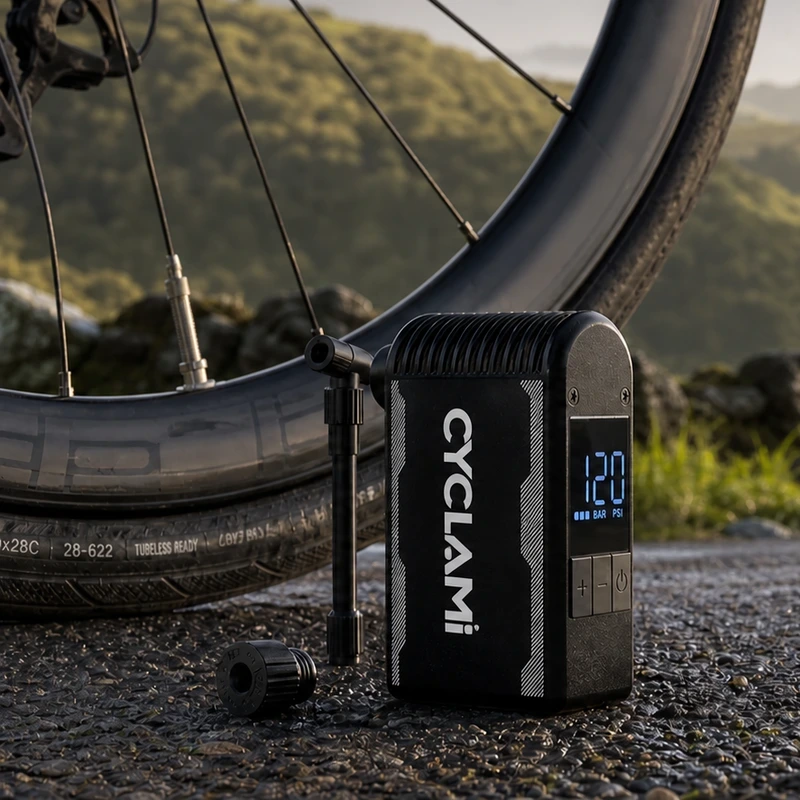
- A preset electric pocket pump. Dial in the manual’s figure, press the chuck on, and it inflates and stops at the target. The CYCLAMI A2S we sell presets anywhere from 0–120 PSI with auto-stop and a manufacturer-stated accuracy of ±1 PSI, takes Schrader natively (Presta adapter and ball needle in the box), weighs 136 g and charges by USB-C. It costs £73.81 at the time of writing; the full spec is here, and our under-£100 electric pump comparison covers the alternatives. It isn’t silent, but a 20-something-PSI top-up is a short, easy job for it — and small tyres barely dent the battery, as our tyres-per-charge breakdown shows.
One honest caveat: Mountain Buggy’s own advice is to use a manual hand pump. The hazard behind that advice is uncontrolled over-inflation from high-powered compressors. A preset pump that shuts off at 20 PSI is engineered around precisely that hazard, but if you would rather follow your manual to the letter, a hand pump with a readable low-range gauge does the same job with more elbow work.
The one-pump household argument
Count the inflatables in a young family’s hallway: three buggy tyres, four tyres across two adult bikes, a kids’ bike or balance bike, plus footballs and netballs. That is roughly a dozen things needing air across two valve types plus a ball needle — and one pump with Schrader and Presta fittings and a needle covers every one of them. Set 25 PSI for the pram, then the right figures for the bikes from our UK bike tyre pressure guide, and 60-odd PSI becomes a football’s bounce. Viewed that way you are not buying a pram pump; you are buying the household’s inflation appliance.
The kerbside top-up, step by step
The goal: back to spec without taking the baby out or the wheel off.
- Learn your number once. Read the sidewall or rim at home and write it on a strip of tape under the seat, or in your phone notes.
- Brake on, dust cap off. Pocket the cap — it keeps grit out of the valve core.
- Set the target on the pump (say, 25 PSI for a Nipper).
- Press or thread the chuck on square to the valve. A short extension hose helps on small wheels where spokes crowd the stem.
- Let it stop itself, refit the cap, and squeeze-check the other tyres while you’re down there.
With a preset pump the whole routine is designed to fit inside about a minute per tyre — a design intent, not a stopwatch figure we have verified, and small-volume buggy tyres sit at the quick end of any pump’s range.
Puncture-proofing a buggy
Ranked from free to committed:
- Keep the pressure right. A properly inflated tyre presents less rubber to the road and sheds debris better. This is the free option and the most neglected one.
- Tube sealant. Slime-type sealant goes in through the valve (core removed) or comes pre-installed in tubes sold in common pram sizes. The manufacturer says it seals tread-area punctures up to 3 mm as they happen and stays effective for up to two years, after which it should be renewed. It will not fix sidewall cuts or a leaking valve.
- Puncture-resistant tubes and tyres. Thicker butyl and reinforced belts cut the odds substantially, but no pneumatic option is puncture-proof.
- Solid or foam-filled tyres. The only true zero-flat choice — at the cost of the air cushioning that made you buy an all-terrain buggy in the first place. A reasonable trade for glass-strewn urban routes; a shame on towpaths and trails.
If one tyre keeps deflating regardless, check the tread for an embedded thorn and test the valve: a dab of spit over the open valve will bubble if the core leaks. A quarter-turn with a valve tool often fixes it; otherwise a new tube is a few pounds.
FAQ
What PSI should pram tyres be?
Whatever your manufacturer states — the figure is moulded into the tyre sidewall, marked on the rim or printed in the manual. As published examples: Mountain Buggy recommends 20 PSI with a 22 PSI maximum, Out’n’About specifies 25 PSI for the Nipper and warns against over-inflating, and Thule’s Urban Glide manuals give 30–35 PSI. If the marking has worn away, ask the manufacturer’s support team rather than guessing high.
Can I use a bike pump on pram tyres?
Yes, in almost every case. Pram valves are nearly always Schrader — the same car-type valve found on many hybrid and kids’ bikes — so any track pump, foot pump or electric pump with a Schrader fitting connects directly. The only real requirements are a gauge you can read accurately at 20–35 PSI and a gentle hand: small tubes reach their maximum quickly, so inflate in short bursts or use a pump with a preset cut-off.
Why does my pram tyre keep going flat?
If it softens gradually over several weeks, that is normal seepage through the tube rubber — small tubes simply show it faster, so monthly top-ups are part of ownership. If it goes soft within a day or two, hunt for a cause: a thorn still lodged in the tread, a leaking valve core (spit over the valve will bubble), or a pinched tube. Fixes are cheap — a patch, a new tube, or sealant that plugs small tread punctures as they happen.
Can I pump up pram tyres at a petrol station?
Best avoided. Mountain Buggy explicitly warns against high-powered service-station compressors: forecourt airlines are designed to fill large car tyres and can blow a small pram tube past its 20-odd PSI ceiling almost instantly, risking the tube and the rim. A hand pump, track pump or small preset electric pump gives you control that a forecourt machine cannot, and it means the fix happens at home or kerbside rather than mid-errand.
Ready to try CYCLAMI UK?
Shop Now — £73.81